Sunday, March 9, 2014

Friday, February 10, 2012
Thursday, January 5, 2012
HEISENBERG'S UNCERTAINITY PRINCIPLE
" It is impossible to determine simultaneously both the position and momentum of sub microscopic particles like electron with accuracy".
EXPLANATION:
Take for example the case of an electron, in order to determine the position of electron inside an atom,we have to use radiations of very small wavelength like x-rays.
Since radiations of small wavelength will have high energy,it changes the normal velocity(so momentum) of the revolving electron.
Thus position is determined with accuracy but momentum with error.
It was experimentally determined that the product of uncertainity in position and momentum is always greater than or equal to h/4 pi.
The following animated video will help you to understand this concept.
EXPLANATION:
Take for example the case of an electron, in order to determine the position of electron inside an atom,we have to use radiations of very small wavelength like x-rays.
Since radiations of small wavelength will have high energy,it changes the normal velocity(so momentum) of the revolving electron.
Thus position is determined with accuracy but momentum with error.
It was experimentally determined that the product of uncertainity in position and momentum is always greater than or equal to h/4 pi.
The following animated video will help you to understand this concept.
Friday, May 6, 2011
ATOMIC STRUCTURE I
QUANTUM NUMBERS
Quantum numbers are nothing but address of an electron.It is used to locate an electron inside an atom.To make it clear think of your address.It contains Name,Door No.,Street name and city name.
Accordingly we also have four quantum numbers.
1.Principal Quantum number
2.Azimuthal Quantum number
3.Magnetic Quantum number and
4.Spin Quantum number.
PRINCIPAL QUANTUM NUMBER
 It is indicated by n.It tells us the shell in which an electron resides.
As the value of n increases,energy of the electron also increases i.e., energy increases as we move away from the nucleus.
AZIMUTHAL QUANTUM NUMBER
 It is indicated by 'l' .It gives us information about the subshell i.e, orbitals in which the electron present.For every n value we have 0 to n-1 values.
"It is like the street name in your address."
MAGNETIC QUANTUM NUMBER
 It is denoted by 'm'.It gives us information about the orientation of orbitals in which the electron resides. The values ranges from -l to + l.
For s orbital m=0 i.e, it has only one orientation.
 For p orbital m= -1,0,+1.i.e., three possible orientations-px,py,pz
For d orbitals m = -2,-1,0 +1,+2
 i.e., five possible orientations- dxy,dyz,dxz,dx2-y2,dz2
"It is like door number in your address"
SPIN QUANTUM NUMBER
 It is denoted by 's'. It gives the information about the spin of electron i.e., either clockwise(+1/2) or anticlockwise(-1/2).
"It is like your name in the address."
Quantum numbers are nothing but address of an electron.It is used to locate an electron inside an atom.To make it clear think of your address.It contains Name,Door No.,Street name and city name.
Accordingly we also have four quantum numbers.
1.Principal Quantum number
2.Azimuthal Quantum number
3.Magnetic Quantum number and
4.Spin Quantum number.
PRINCIPAL QUANTUM NUMBER

As the value of n increases,energy of the electron also increases i.e., energy increases as we move away from the nucleus.
"It is like the city name in your address."

"It is like the street name in your address."
MAGNETIC QUANTUM NUMBER

For s orbital m=0 i.e, it has only one orientation.

For d orbitals m = -2,-1,0 +1,+2

"It is like door number in your address"
SPIN QUANTUM NUMBER

"It is like your name in the address."
Saturday, February 19, 2011
ATOMIC STRUCTURE-d-orbitals
SHAPES OF d-ORBITALS
The magnetic quantum number(m) for d- orbital are -2,-1,0,+1,+2It shows that d- orbitals have five possible orientations
Accordingly there are five types of d- orbitals- dxy,dyz,dxz,dx2-y2 and dz2
dxy,dyz and dxz are clover leaf shaped with four lobes along the respective planes.
i.e.,in dxy orbital the lobes are in xy plane
In dyz orbital the lobes are along yz plane
In dxz orbital the lobes are along xz plane
In dx2-y2 oorbital the four lobes are along the x and y axis
Tuesday, February 15, 2011
CHEMICAL KINETICS
ACTIVATION ENERGY
We know that nitrogen and oxygen combine to form nitrogen oxides.
Here is an interesting question. Air contains both oxygen and nitrogen, but why they do not combine to form nitrogen oxides by themselves.
To know the answer we should know what is activation energy?
" It is the additional energy required by the colliding molecules to attain threshold energy in addition to its potential energy."


 .
.Now you can see that nitrogen and oxygen have reacted to form nitric oxide.Also the P.E difference between the reactants and products is taken as enthalpy change.Here it is positive thus an endothermic process.
So what's the answer for the question asked before? yes nitrogen and oxygen in air needs activation energy to form nitric oxide.Unless they get it they wont react with each other.
Thursday, February 10, 2011
SOLID STATE - CRYSTAL STUDIES
Bragg's spectrometer method
 Note the deflection in the electrometer i.e, at this angle the current is very low
 The current strength is gradually increasing
 At this angle the maximum diffraction occurs,thus it is taken as first order reflection i.e., n = 1

Again when you increase the angle current drops to minimum and maximum reflection occurs at another higher angle,which can be taken as second order reflection.
- X-rays are used to study the crystal structures.
- Bragg's spectrometer works on the principle of diffraction.When X-rays produced from coolidge tube are made to fall on the crystal at a particular angle of incidence,the rays gets diffracted and enter the ionisation chamber and ionise the gas present in it.Thus current is produced,which is measured by an electrometer.
- The current strength is a direct measure of intensity of the diffracted rays.
- Here you can see a real Bragg's spectrometer


Again when you increase the angle current drops to minimum and maximum reflection occurs at another higher angle,which can be taken as second order reflection.
Wednesday, February 9, 2011
ELECTROCHEMISTRY II
Electrochemical Series
"Electrochemical series is a list of metal electrodes arranged in the decending order of standard reduction potentials."


"Electrochemical series is a list of metal electrodes arranged in the decending order of standard reduction potentials."
- Standard reduction potentials of electrodes can be determined by connecting the electrode with standard hydrogen electrode, whose reduction potential is arbitarily taken as zero volts.
- According to IUPAC conventions SHE should always be connected in the right hand side.
- Let's determine the standard reduction potential of zinc electrode as follows

- Thus the reduction potential of zinc is found to be - 0.76 V .The negative sign shows that zinc cannot be reduced easily i.e., it can easily undergo oxidation.
- Since the metals are arranged in the decending order of reduction potentials, the metals present in the top of the series undergo reduction(strong oxidising agents) and the metals present below undergo oxidation(strong reducing agents).
Saturday, February 5, 2011
CARBONYL COMPOUNDS
TOLLEN'S AND FEHLING'S TESTS
These two tests are used to identify the aldehydes and to distinguish them from ketones.
Tollen's reagent - silver nitrate + ammonium hydroxide
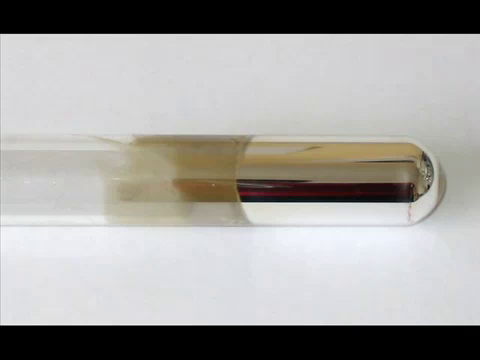
Aldehydes can reduce Tollen's reagent to metallic siver,which is deposited along the side walls of a test tube forming a silver mirror.(silver mirror test)

Fehling's solution - copper sulphate + sodium potassium tartarate
Aldehydes can reduce Fehling's solution,so that blue cupric ion is reduced red cuprous oxide.

ISOMERISM IN ORGANIC COMPOUNDS
CONFORMATIONS OF CYCLOHEXANE
" Conformations are various forms of a molecule which arise due to C-C single bond rotation."

Cyclohexane exist in two forms called chair and boat forms.
Cyclohexane contains totally 12 C-H bonds. These bonds are classified into two types axial bonds and equitorial bonds.
Axial bonds (blue coloured ) are those parallel to the molecular axis
Equitorial bonds(red coloured) are those at 70 or 110 degree to the molecular axis.
The chair form can interconvert itself to another chair form where all the axial bonds become equitorial and vice versa.

i.e., in the fig. now all the red becomes axial and all the blue become equitorial.
Saturday, January 1, 2011
What is chemistry?
"The study of the matter, its composition, properties, and the changes it undergoes."

Branches of Chemistry
Analytical Chemistry -studies composition of substances.
Organic Chemistry -compounds containing carbon
Inorganic Chemistry -substances without carbon
Biochemistry- Chemistry of living things
Physical Chemistry studies behavior of substances
– rates and mechanisms of reactions
– energy transfers
Why to study chemistry as a subject in higher secondary level?
- To understand the natural world
- Prepare for a career
–Directly- in a lab
So i have planned to discuss some important concepts of higher secondary chemistry course in the upcoming posts,which the students feel difficult to understand in the class room teaching.Also it will be usefull to prepare yourself for entrance examinations like AIEEE,IIT,JIPMER,etc..
Subscribe to:
Posts (Atom)